
Latest News: OHA - Enhancing How Patients and Care Teams Connect →
Despite rapid advancements in clinical technology, the primary interface for patient-to-nurse communication remains fundamentally unchanged since the mid-19th century. This article examines the historical "context-void" alert system, its contribution to the current $4.1B annual cost of nurse turnover, and evidence-based non-technological and technological interventions to optimize clinical workflows.
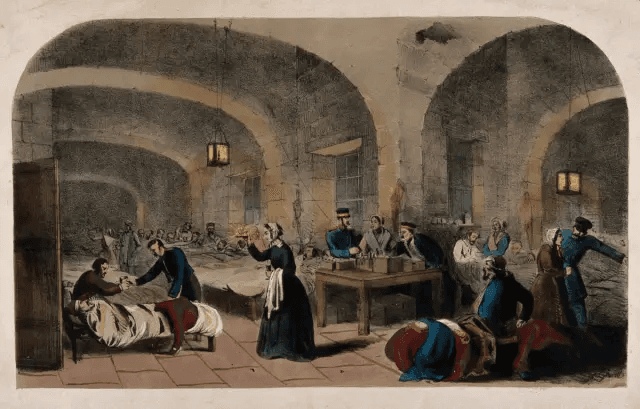
The nurse call bell is one of the oldest technologies still in daily operation within the modern hospital. Its origins trace back to the late 1800s, when mechanical bell systems were installed to allow patients to summon help without shouting down corridors. Remarkably, the core interaction hasn't changed since. A patient presses a button. A bell rings. A nurse responds, eventually.
Over the decades, the bell became electronic, then digital. Lights were added; chimes were softened; displays became brighter. Yet fundamentally, the system still treats every request as identical, every unit as flat, and every response as manual triage performed under pressure. In an era of smart infusion pumps, real-time location systems, and AI-assisted diagnostics, the nurse call bell remains a polite way for patients to say:
"Something is wrong. Good luck figuring out what."
This "signal-only" technology creates a context vacuum.
Even without new technology, healthcare leaders can make measurable gains by tightening workflow around existing systems. Three proven, low-cost interventions stabilize nurse responsiveness and improve patient experience:
Moving from reactive to proactive care starts at the bedside. Intentional rounding to check on Pain, Position, Possessions, and Potty keeps basic needs from turning into call lights. Research shows this simple framework can cut call volumes by nearly 40% and reduce falls by 20%.
Yet rounding is labour-intensive. Its success depends on consistency and time, both constrained by staffing shortages. When patient load spikes, rounds slip, and the system reverts to reactive mode.
Many units have expanded the scope of volunteers and unit aides to handle non-clinical needs. This is an excellent use of resources, but it creates a coordination bottleneck. Because the call bell cannot distinguish a request for ice chips from a request for pain medication, the nurse is still forced to answer the bell, assess the need, and then hunt down a volunteer. The interruption still happens.
Pairing RNs with RPNs/LPNs or PSWs creates resilience and distributes the physical workload. However, without a system that supports role-based routing, this model relies heavily on organizational knowledge and verbal handoffs. When a bell rings, the system doesn't know who in the triad should respond. Teams rely on hallway conversations and best guesses, keeping the cognitive load high even when staffing is adequate.
While analog strategies offer a floor for improvement, they cannot solve the fundamental "context vacuum" of 1850s technology. Modern patient request workflows must move toward Digital Triage.
The hospitals making the biggest gains in patient satisfaction scores, nurse retention, and operational efficiency aren't trying to "fix" the call bell. They are redesigning the workflow that sits on top of it.
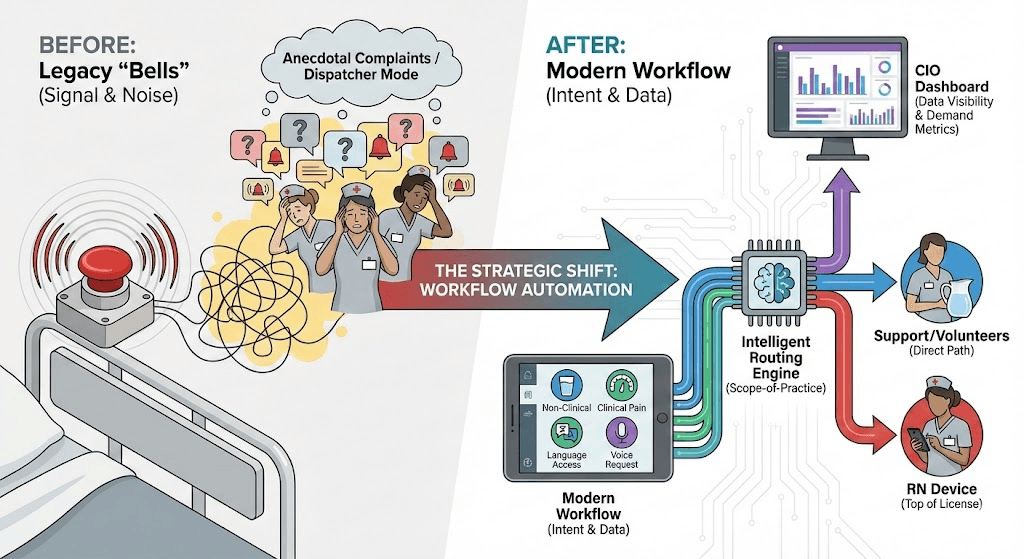
Modern systems allow patients to express what they need — pain support, mobility assistance, water, or spiritual care — through accessible, bedside interfaces. When the system captures intent, requests change from interruptions into actionable information.
Once the intent is known, the request is distributed based on scope of practice.
Hospitals recognize that a single physical button fails to serve patients with limited mobility, language barriers, or sensory impairments. By utilizing systems that offer translation, voice activation, and adapted interfaces, hospitals are not just improving experience; they are advancing health equity and mitigating the legal risks associated with failure to communicate.
Perhaps most importantly for hospital leadership, modernizing the request workflow turns "noise" into "data." Instead of anecdotal complaints about response times, Clinical Managers and CIOs gain visibility into unit demand.
The nurse call bell has survived not because it is effective, but because it is familiar. But that comfort now comes at a cost. A system built on undifferentiated noise isn't just outdated. It's a structural flaw that compromises both patient safety and staff retention.
The future of patient experience will not be defined by higher decibel alarms or faster arrival times to a context-void "ding." It will be defined by the intelligence of the response. Transitioning to a context-aware ecosystem is no longer a luxury of "innovation." It is a foundational requirement for a sustainable nursing workforce. It is time to stop requiring nurses to manage signals, and start empowering them to manage care.